Next weekend, I’ll be joining a group of friends in an attempt to summit the famous Half Dome in Yosemite via the Cables Route. In anticipation of this upcoming adventure, I thought I’d write a little bit about one of my favorite explorers and naturalists, John Muir, and his legacy with Yosemite.
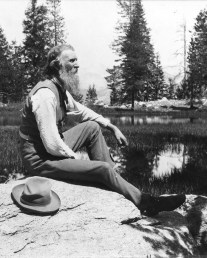
Often touted as the “father of the conservation movement,” John Muir found inspiration and sanctuary in Yosemite. He spent time there, but not as much time as people often think, his longest stint being 22 months starting in 1871. However, the time he did spend in Yosemite was invaluable, and shaped his ideas and opinions regarding conservationism and the natural world. It was John Muir, along with Robert Underwood Johnson, who originally planned the borders of a National Park of Yosemite, who petitioned Congress, and eventually helped to achieve Yosemite’s National Park status in 1890, one of the first National Parks in United States’ history.
John Muir was an immigrant from Scotland. He and his family moved to Portage, Wisconsin when he was 11 years old in 1849. He worked on his family farm for many years, all while tinkering with his own inventions and reading. When he was almost 30, Muir finally acknowledged his unquenchable thirst for adventure, connecting with Nature, and discovering the beauties of the natural world. He set off on a 1,000 mile walk, from Kentucky to Florida, where he planned on continuing to South America. However, he was stricken with Malaria in Florida and was forced to abandon his adventure to the Amazon.
Muir travelled to San Francisco by boat, using the Panama Canal. He arrived in San Francisco in 1868 and quickly set off to find the wild. He soon arrived in Yosemite and was stricken by its beauty. His first stay would last only 10 days (he returned to the cost to find work), but he would return to Yosemite in a year.

Yosemite was already becoming a tourist destination. It was first discovered by white men in the early 1850s, when the California Government paid a group of vigilantes to “stop” Native American tribes from attacking trading posts. The vigilantes chased the Native American tribe through Yosemite, murdered many, and burned their village. Upon their return to the coast, the vigilantes told stories of a beautiful, 7 mile valley lined by majestic cliffs. It was not long before “tourists” would start taking the 200 mile trek from San Francisco to see this beautiful creation.
When Muir first arrived in Yosemite, it was already a fairly popular destination, with inns and an apple orchard built in the valley. In 1864, a group of Californians had the foresight to petition President Abraham Lincoln to protect the 7 mile valley by signing into law that it would be owned by the state for “public and recreational use.” Muir’s first 10 days there must have been awe inspiring, because it would help to form the rest of his future there.
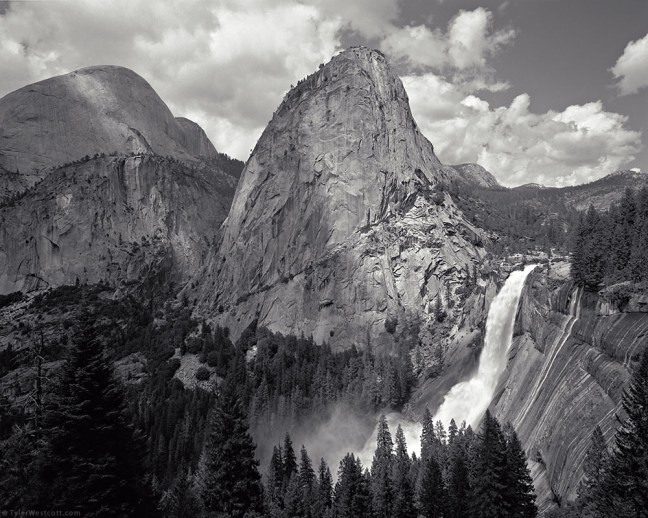
In 1869, Muir was hired as a shepherd for a large flock of sheep, and was to take the sheep to the High Sierra’s for grazing. He later wrote of his hatred of these sheep in his book, My First Summer in the Sierra, because the devoured the grasses and wild alpine flowers. During his shepherding job, Muir often hiked and climbed many of the peaks of the High Sierras, and it was this beautiful landscape that pushed him to stay in Yosemite. He decided in the fall of 1869 to stay in Yosemite full time, and he built and operated a saw mill for a local Yosemite Inn (the Hutchings House Hotel). During his 11 months in Yosemite, Muir spent his time guiding tourists around Yosemite and building wooden partitions for the guest rooms of the hotel. While he fell in love with the splendor around him, writing things like “I am feasting in the Lord’s mountain house,” he missed his family and friends, and in 1870 wrote to his friend, Jeanne Carr, back in Wisconsin, “I find no human sympathy, and I hunger.” In late 1870, Muir left Yosemite.

Muir would return shortly after leaving, in January of 1871. This time, he spent 22 months there, his longest consecutive time in Yosemite. He continued to work at the sawmill, but on days off he would explore Yosemite and chronicle its geology, flora and fauna. It is during this time that Muir really became knowledgable about Yosemite Valley, and would fill journal upon journal of his discoveries and time in the valley. It is also in 1871, that Muir would begin to make a name for himself as a philosopher of nature and expert on wilderness. His dear friend, Jeanne Carr, moved to Oakland and would spend much time with the elite literati of the city. He spread Muir’s insight, and Muir quickly became known as a genius. A notable scientist, Joseph LeConte, was impressed with John Muir’s theory that the valley had been formed by glaciers and not by some cataclysmic event (which most thought to be true), that he urged Muir to publish a scholarly article, which Muir did and was first published in the New York Tribune in 1871. This put Muir on the map, and many noted naturalists, scientists, writers, and politicians would hold Muir in high regard.
It is at this time that Muir made a personal sacrifice that defined his status as a conservationist. While he was becoming popular among the social elites of San Francisco, he yearned for the wilderness. It was with great difficulty, but utmost wisdom, that Muir saw his place in the wilderness changing, from an avid enthusiast and consumer of the wild, to its protector. Muir was writing for outdoor magazines and his thoughts on nature were receiving wide circulation and acceptance. He visited Yosemite again in 1874 after a 9 month hiatus, only to feel that he was a stranger, but also accepting his new responsibility as its protector. However, if he were to be a protector of the wild Yosemite, he could no longer be a hermit in the valley, but must be an advocate in the wider world. After his visit in 1874, he wrote to his friend Carr that, “this chapter of my life is done.”

In 1889, during a camping visit to Yosemite with Robert Underwood Johnson, Muir and Johnson would put together a plan to protect 1200 square miles of Yosemite. They created the plan to turn Yosemite into a National Park, one of the first in the country, and they lobbied congress with their plan. Congress would pass the legislation in 1890, creating Yosemite National Park. In 1903, Muir and President Theodore Roosevelt camped together in Yosemite for 3 days. It is believed that during this time, Muir was able to convince Roosevelt to expand the National Park System, and increase the protected land area of Yosemite National Park. Muir would continue to fight for conservationism, particularly of the High Sierras. He fought against the construction of a dam within the Yosemite National Park, but he lost the fight in 1913. Muir would die from pneumonia in 1914. However, the battle against the dam garnered much support and ignited the conservation movement which would lead to the creation of the National Parks Service and increased protection of the National Parks in the United States, something that we must all cherish.
Muir was an explorer, naturalist, scientist, writer, and conservationist. His love for the wild, the High Sierras, and Yosemite Valley fueled his desire to protect these beautiful sanctuaries, and he is someone we must all be thankful for because without him, who knows what wilderness would still exist.
I look forward to following in some of his footsteps while I explore Yosemite Valley and attempt to summit Half Dome in the next week and half. I’ll be sure to post about my trip once it is complete.
Thanks to the Smithsonian Institute for much of this insight:
http://www.smithsonianmag.com/history/john-muirs-yosemite-10737/?all
 Kayak Camping Catalina Island